

- ISBN-10: 052127494X
- ISBN-13: 978-0521274944
|
Aircraft
Construction Books
|
||
|
|
|
|||||
These aircraft construction and Airplane Maintenance Books have a tremendous amount of information for the new or seasoned Homebuilt Aircraft - Airplane Builder.Homebuilt aircraft construction of kitplanes and airplane kits, Aerocrafter, composite construction, Aero elasticity, Mechanics of aircraft structures, modern combat aircraft design, military aircraft, military airplanes and more. If you like to build kitplanes made from composites, metal, or wood this aircraft construction page will help. Aerocrafter Homebuilt Aircraft Sourcebook |
Survival Equipment - Survival Supplies *
Airplane
Construction Videos
Books for airplane homebuilders about aircraft & Homebuilt Kitplane construction |
||
 |
0521657229Introduction
to Aircraft Design (Cambridge Aerospace, 11) by John Fielding Softbound Book 0521657229 Book Description Book Info |
|
 |
156027140XAerodynamics
for Naval Aviators (reprint ed)/ 676-T by Federal Aviation Association (Editor), H. H., Jr. Hurt 156027140X Book Description This textbook presents the elements of applied aerodynamics and aeronautical engineering that directly relate to the flight training and general flight operations of naval aviators. 13.57 |
|
 |
0830639012The
Illustrated Guide to Aerodynamics by H.C. 'Skip' Smith Softbound Book 0830639012 Book Description From the webmaster: I have read this book. I have to give it a 5 star rating. There was a lot of information with great explanations of how things worked.. I learned new terms like Rho and Flat Plate Area. I highly recommend this book. C. Jeff Dyrek |
|
 |
0521669553A
History of Aerodynamics: And Its Impact on Flying Machines by John David Anderson, Jr., John D. Anderson 0521669553 Book Description |
|
|
|
Model Aircraft Aerodynamics Softbound Book |
|
|
|
Hamilton Standard Coffee Mug Airplane Gift Idea 13.96 |
|
 |
0837601428Race
Car Aerodynamics : Designing for Speed by Joseph Katz 0837601428 Book Description Webmasters Note: Why are race car aerodynamics books placed on this site? It's because these guys spend millions trying to get every ounce of drag reduction out of these cars, there's big money at stake and there may be some important lessons that can be learned from the race car industry that us aero-nuts can learn. C. Jeff Dyrek |
|
|
|
Test Flying Softbound Book |
|
| A Practical Guide to Airplane0001939325"> |
A Practical Guide to Airplane
Performance and Design Crawford Crawford. Leads you through the basic design procedures, using novel graphic techniques to eliminate tedious calculations. Using a plastic template and worksheets provided, you will be able to quickly predict the performance or see the results of changing design features for any unpowered or prop driven aircraft with a weight up to 4,000 lbs. Examples used are Gossamer Albatross, Thorp T-18, to the Cessna 172. Includes template and pad of worksheets, heavily illustrated. 8"x 11", sfbd.0001939 |
|
 |
0486605868Theory
of Wing Sections
Including a Summary of Airfoil Data (Dover Books on Physics) by Ira H. Abbott, Albert E. Von Doenhoff (Contributor) Paperback - 430 pages 4 edition  0486605868
This is a well written book that aircraft designers and those engaged in a
serious study of wing aerodynamics will find useful, helpful and handy. This is
not a book for the novice but for aeronautical engineering specialists who can
handle fluid dynamics theory, performance and other mathematical manipulations.
Although the book has been around for some time (I first used it at university
as a recommended text in aerodynamics over 25 years ago), the theory and
concepts are still very much relevant and applicable today.
|
|
|
|
by Richard Von Mises, Richard Von Mises Softbound Book A 5 Star Rating The classic treatment examines probability theory, its relation to statistics, and its truth-finding value. A renowned mathematician, scientist, and philosopher derives the logical concept of "probability"; considers theories of Pascal, Laplace, and others; and explores laws of large numbers. This lucid treatment requires no prior knowledge of mathematics.
To say the text is a classic work on the subject is an understatement. It offers a lucid introduction to the many concepts of aeronautical design that traditionally challenge students. It is a required text for those wishing to advance their understanding of theoretical aerodynamics and its profound implications toward applied aircraft design. Though prerequisite knowledge of aeronautics will augment the text, none is assumed by the author and the mathematical derivations presented within are complete. Most of the empirical data and equations are still quite valid although the text was printed decades ago, before aerodynamics attained its current level of analysis. Anyone involved in the development of subsonic conventional aircraft will want to add this to their research library as a valuable reference. 0001577
1
|
|
 |
0486672131Engineering
Analysis of Flight Vehicles by Holt Ashley 0486672131 Book Description
Excellent graduate-level text explores virtually every
important subject in the fields of subsonic, transonic, supersonic and
hypersonic aerodynamics and dynamics, and demonstrates how they interface
with and complement one another in atmospheric flight vehicle design. Broad
selection of helpful problems at the end of each chapter. Bibliography. "A
fine book..."—Canadian Aeronautics and Space Journal. 1974 edition.
|
|
|
|
Aircraft Detail Design Manual Softbound Book |
|
|
Positive Flying0002736378"> |
Positive Flying Hardbound Book 2 |
|
Experimental Airplane Models |
||
 |
052127494XThe
Elements of Aerofoil and Airscrew Theory by Hermann Glauert 052127494X Book Description More than half a century has elapsed since the first edition of The Elements of Aerofoil and Airscrew Theory appeared in 1926, a period in which massive advances have been made in the understanding and description of aerodynamic phenomena. Yet Glauert was an acknowledged master of his subject and his book remains the most lucid and best organised introduction to the fundamental principles of aerodynamics that has ever been written. This new paperback edition reprints the text of the second edition of 1947, with supplementary notes by H. B. Squire.
|
|
|
|
0486648990Aerodynamics
of Wings and Bodies by Holt Ashley, Marten Landahl (Photographer) Paperback - 279 pages (August 1985) 0486648990
Book Description
This excellent, innovative reference offers a wealth of useful
information and a solid background in the fundamentals of
aerodynamics. Fluid mechanics, constant density inviscid flow,
singular perturbation problems, viscosity, thin-wing and slender
body theories, drag minimalization, and other essentials are
addressed in a lively, literate manner and accompanied by diagrams.
|
|
| I/41XNZ2N3KZL._AA240_.jpg" ALT="Rotary Wing Aerodynamics" HSPACE=3 BORDER=2 height=240 width=240> |
0486646475Rotary
Wing Aerodynamics by W. Z. Stepniewski, C. N. Keys (Contributor) 0486646475
Book Description
Clear, concise text covers aerodynamic phenomena of the rotor
and offers guidelines for helicopter performance evaluation.
Originally prepared for NASA. Prefaces. New Indexes. 10
black-and-white photos. 537 figures.
|
|
 |
0486682307
Helicopter Theory by Wayne Johnson 0486682307
Book Description
Monumental text offers comprehensive, detailed coverage of every
aspect of theory and design: elements of vertical flight, forward
flight, performance, mathematics of rotating systems, rotary wing
dynamics and aerodynamics, aeroelasticity, stability and control,
more. Essential reading for those interested in design and
development of vertical-flight aircraft. 189 illustrations. 1980
edition.
|
|
| I/312yDcHVlKL._BO2,204,203,200_PIsitb-dp-500-arrow,TopRight,45,-64_OU01_AA240_SH20_.jpg" ALT="Aircraft Design: A Conceptual Approach" HSPACE=3 BORDER=2 height=240 width=240> | 0930403517
Aircraft
Design: A Conceptual Approach, Second Edition by Daniel P. Raymer 0930403517 Book Description The book presents design topics in the order in which they typically occur during a design project. The analysis techniques presented are simplified to permit the student to experience the whole design process in a single course, including the key concepts of trade studies and aircraft optimization. |
|
|
Aerocrafter
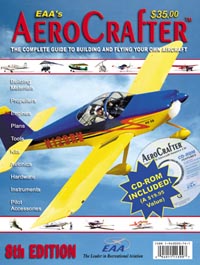
: 750+ Aircraft You Can Build and Fly by Don Purdy (Editor) Paperback - 432 pages 5th edition (January 1998) aerocrafter is a great book Book Description EAA continues to enhance programs that meet the needs of builders and restorers. Some of the most recent additions are the Homebuilt Aircraft council, which includes experienced builders from throughout the country who help form policy and programs to assist EAA members; Homebuilders' Headquarters on the EAA members' website, which offers detailed information for builders and restorers; and the EAA SportAir Workshops, with hands-on experience for a particular type of airplane or in a variety of building and restoring skills. EAA's other resources can also help make your project a success. Technical Counselors and Flight Advisors are ready to help so both your project and piloting skills are ready when it's time for that first flight. EAA Chapters are perfect places to find people locally who match your enthusiasm for the world of flight. Of course, EAA Air Venture Oshkosh continues to be the ultimate destination and live education resource for aviation enthusiasts. This new edition of AeroCrafter fits well with EAA programs and activities. There are a number of new features in this edition that enhance its value. One of the most important is the accompanying CD-ROM that contains information in an easy-to-use format for your computer. |
|
|
|
Kern. Hardbound Book A textbook on such subjects as personal flight integrity, managing cockpit crises, prioritizing tasks, structure changing situations, procedural and regulatory discipline, and communications discipline. A personal improvement tool that might just help the average pilot avoid a lethal pitfall like “get-there-it-is”, macho attitude, pressure from company superiors or passengers. A blueprint for excellence in step-by-step detail. 412 pgs., 6"x 9", hdbd .....#0001743 |
|
|
|
Dzik. Softbound Book This book is for the student, the designer, or the individual whose aim is to design and build his own helicopter. Chapters cover: Preliminary & Advanced Aerodynamics, Helicopter Controls, Design Sketches, Roto Blades, Adhesive Bonding and Theory of Flight. Numerous drawings, 118 pgs., 6"x 9¼", sfbd.0001424 |
|
 |
Stop
Abusing Bernoulli! - How Airplanes Really Fly by Gale M. Craig The author, Gale Craig , January 12,
2000 Strangely, although we think of
airplanes as flying through relatively still air, popular explanations
of wings describe them as stationary in passing flow. Let's consider a
still air and moving wing perspective, which is advantageous for understanding
circulation. Accept as fact that an upward lifting wing in forward motion
in relatively still air has reduced pressure above the upper surface,
and increased pressure below. Now let's recognize that air mass accelerates
in response to the applied force of pressure, according to Newton's laws.
Pressure gradients propagate at the speed of sound, reaching ahead of a
lifting wing to produce acceleration of air away from higher pressure
below and toward lower pressure above. This produces forward movement below
the wing leading edge, upward movement ahead of the leading edge, and rearward
movement above, all in response to pressure difference. As the trailing
edge approaches, the forward and rearward air movements dissipate in encounter
with opposing pressure gradients. Air left behind the trailing edge
as it departs has only the downward movement.. |
|
 |
Mechanics
of Flight by R. H., Ph.D. Barnard (Editor), D. R., Ph.D. Philpott (Editor), Alfred C. Kermode Book Info |
|
Pitts Aircraft Construction Exhibit

082122168XWomen and Flight : Portraits of Contemporary Women Pilots |

1556523106Fire and Air : A Life on the Edge 1556523106by Patty Wagstaff, Ann L. Cooper |


Here for a list of WW2 Fighter Groups
Click Here to go to the YellowAirplane Online Museum
Look at these exhibits and tell me what these men really fought for.
The 34th Fighter SquadronThe 34th fighter Squadron
WW2 Exhibit
About the Webmaster, Why God Send Me to the North Pole
Click here to see how I have to live and what it looks like to be
a disabled Vet.
| . |