
North Pole Expeditions,  famous explorers and early explorers that went to the poles.
YellowAirplane.com

List, Books and Videos of North Pole & South Pole Famous Explorers and Early Explorers.
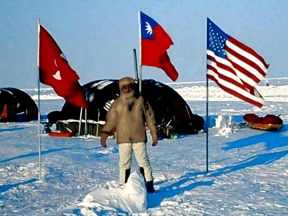
North Pole Expedition 2001 photo of an unknown explorer. Who really went to the North and South Poles and When.  This is a continuously growing list of Books, Videos and DVD's of North Pole and South Pole Explorers.

The complete list of early famous explorers from early explorers to the modern day polar globe explorer.

Books and descriptions on famous explorers from early explorers to modern day globe explorer that went to the North Pole and South Pole.

Some of the famous explorers made it to the poles and some of them died trying, and yet, it is believed that some of the early explorers just said that they made it to the pole.  Not to long ago going to the North Pole was an extremely dangerous expedition but now, getting to the North Pole, is just another vacation package guided by professional guides.  Many of the people that you find on these expeditions are just the modern day globe explorer. While many of these people are modern day globe explorers. You can find other north pole pages by using these search words:  north pole, north pole tours, polar, arctic, arctic exploration, north pole expeditions, polar expeditions.  Or just click on this link for North Pole Tours.  At this link, you too can become a real globe explorer also.

North Pole Expedition 2001.  *  North Pole Expedition 2002.  *  North Pole Expedition 2003.  *  North Pole Expedition 2005.

To the Main Entrance of the Yellow Airplane StoreGo to the Stores Front Door to see much more

   Go to the North Pole adventures page     | Go to the North Pole for a vacation yourself

You too can go to the North Pole.

With today's technology and all of the knowledge gained
from the people listed on this page, going to the North Pole
is just an adventure vacation.  In Mid April, the temperatures
are between -10 and -35 degrees F.  This is
equivalent to an Illinois Winter.
Click here for more information on North Pole and Arctic Travel
 
Click Here to go to the
Yellow Airplane Online Museum
Home Page.

Visit the Yellow Airplane Super Store

This is part of a North Pole, Arctic and Antarctic study that I am making for my personal knowledge of famous explorers that went to the poles and they were also a globe explorer.

Their are some people omitted in this list.  The more I read about famous explorers, the more people that I find that were part of these expeditions and had expeditions of their own.  Many of the dates cross over the other dates and some of the dates were really just a blur in my mind.   So far I haven't found any site that covers every explorer or has a large account of the expeditions in the order of the dates of these expeditions.  I'm doing the best I can to insure the accuracy of this page and it's links, but the more I learn, the more revisions that have to be made.  This can only mean that there are errors that I have yet to encounter.  C. Jeff Dyrek, Webmaster, Arctic Explorer.  You can read about my personal expeditions at the links at the bottom of this page.
1845 Sir John Franklin set out to find the North West Passage and never retuned.  He started his adventure with two ships the,  HMS Terror and the HMS Erebus, and 128 men on this journey which has become the greatest disaster in Arctic history.  Here are some links that explain the entire story.
http://www.ric.edu/rpotter/SJFranklin.html
http://www.ric.edu/rpotter/franklife.html
http://members.home.net/mullington/
1893 - 1896  Fridtjof Nansen Drifted in the frozen ice from Siberia towards the North Pole on the ship "Fram"  During the time when his ship was frozen in the ice, he made a dash for the North Pole on ski's and dogsleds but never made it to the North pole.
http://www.mnc.net/norway/Nansen.htm
http://www.fni.no/
http://www.nb.no/baser/nansen/english.html
1894 Jackson-Harmsworth Arctic expedition.
1897, July 11th,   Salomon August Andree. 
Headed for the North Pole in a Hot-Air Balloon.  After a three day flight they make an emergency landing on the ice.  They walked on the ice pack for three months and in October they reached White Island where their bodies were found 33 years later.  They never made it to the North Pole.
http://www.bartleby.com/65/an/Andree-S.html
http://school.discovery.com/homeworkhelp/worldbook/atozhistory/a/723436.html
http://ku-prism.org/polarscientist/andreemystery/andreeindex.html
1898 Adrien de Gerlache de Gomery:  the first expedition to stay the winter in Antarctica.  Their expedition was to explore the coast of Antarctica when their ship was stuck in the Ice for 13 Months.  Amundsen was on this crew.
http://www.findagrave.com/pictures/4492.html
http://www.uib.no/People/nglbn/belgica.htm
1903 - 1905  Roald Amundsen:  Born 1872 at Borge, near the town of Sarpsborg, in southeast Norway.    Set out to find the North West Passage and study the Magnetic North Pole.  Found a natural harbor on King William Island, northwest of Hudson Bay.  The Expedition remained at this port for two years and named it Gjoahavn.  From the Eskimos, Amundsen learned how to drive a dog team what kind of clothes the Eskimos wore, their customs and what type of food they ate.  Their expedition was successful and the "Gjoa" was the first ship to travel the Northwest Passage.  5 Dec 1905 the news of this expedition has reached the world from a town named Eagle City Alaska.
http://www.south-pole.com/p0000101.htm
http://www.mnc.net/norway/roald.html
http://www.iol.ie/%7Ejomerps/HomePage/Projects/World_Explorers/Roald_Amundsen.html
1909, April  Robert Peary / Matthew Henson had been successful in being the first man to reach the North Pole.
Robert Perry and Mathew Hensen set off for the North Pole in 1909.  He came to the conclusion that it would be safer to travel to the pole in late winter than during the summer because the ice was much firmer and there were fewer Leads (Cracks).  They also realized that it would be easier to reach the pole from Canada's Ellesmere island than the previously thought Greenland.  Peary and his entourage of 23  men, 133 dogs, and 19 sleds set off from Ellesmere Island on March 1, 1909.   As the Expedition continued, the crew has been reduced in size and weight where bBy the time April 6, 1909, rolled around, only six men, Peary, Henson, and four Eskimos,  Oatah, Egingwah, Seegloo, and Ookeah.
1909 Expedition to the North Pole
Robert Perry on top of the World  
1911, December 14th,  Roald Amundsen was the first man to stand on the South Pole.
1914 Sir Ernest Shackleton tried to make the first crossing of Antarctica.  The ship "Endurance" became trapped in the Weddell Sea ice.  The twenty seven man crew was stranded for months on the ice pack and escaped to Elephant Island where Ernest devised one of the greatest rescues of all time.
1912 January,   Robert F. Scott
believed that he was the first to reach the south pole.  However, he found the remains of Roald Amundsen's camp and realized they got there first.  Click here to see the only other attempt to cross the Antarctic Continent by land by Curtis Lieber modern day explorer  Robert Scott made it to the pole after an extremely exhausting journey.  The weather was much worse than expected, their supplies were always running short and the said it was more work than they ever expected a man can do.  Their return trip was even more arduous.  Their depots were seventy miles apart and when they got to the depots, they found that much of the fuel in the poorly sealed cans had evaporated leaving them cold and required them to eat meat that was only only partially cooked. Robert Scott and his team died after a journey that left them frozen and frostbit with no hope for survival.  Robert Scott wrote twelve letters to his family and friends.
Robert Falcon Scott a large bio This is a real great story.  
 
 
The Worst Journey in the World
by Apsley Cherry-Garrard

Amazon.com 
As Apsley Cherry-Garrard states in his introduction to the harrowing story of the Scott expedition to  the South Pole, "Polar Exploration is at once the cleanest and most isolated way of having a bad time which has been devised." Cherry-Garrard's The Worst Journey in the World is a gripping account of an expedition gone disastrously wrong. The youngest member of Scott's team, the author was later part  of the rescue party that eventually found the frozen bodies of Scott and three men who had accompanied Scott on the final push to the Pole. These deaths would haunt Cherry-Garrard for the rest of his life as he questioned the decisions he had made and the actions he had taken in the days leading up to the Polar Party's demise. 

Prior to this sad denouement, Cherry-Garrard's account is filled with details of scientific discovery and anecdotes of human resilience in a  harsh environment. Each participant in the Scott expedition is brought fully to life. Cherry-Garrard's recollections are supported by diary  excerpts and accounts from other teammates. Despite the sad fate of Scott, the reader will grudgingly agree with the closing words of The Worst Journey in the World: "Exploration is the physical expression of the Intellectual Passion. And I tell you, if you have the desire  for knowledge and the power to give it physical expression, go out and explore.... If you march your Winter Journeys you will have your reward, so long as all you want is a penguin's egg." 

 Introduction to the British 1994 edition   "A masterpiece. ... When people ask me (I get the question about twice a month), 'What is your favorite travel book?' I nearly always  name this book. It is about courage, misery, starvation, heroism, exploration, discovery, and friendship. It vividly illustrates the demands  of science and the rigors of travel. It is a record of the coldest darkest days that can be found on our planet. It is written beautifully but  not obviously, with a subtle artistry. ... It is rare to find a person who is at once a great traveler, recounting an overwhelming experience,  and who is also such an accomplished writer. ... Everywhere his voice is clear, articulate and humane and sometimes startling."--Paul Theroux.


Scott's Last Expedition  The Journals
by Robert Falcon Scott, Beryl Bainbridge

Amazon.com 
In November 1910, a ship called Terra Nova left New Zealand on its way south to Antarctica. On board was an international team of  explorers led by Robert Falcon Scott, a man determined to be the first to reach the South Pole. A year and a half later, Scott and three  members of his team died during a brutal blizzard. Their dream of reaching the Pole first had already been dashed by the Norwegian  explorer Roald Amundsen, and now on their return trip--slowed by ill health and bad weather--Scott's party found themselves trapped in a tent without sufficient provisions, while the wind howled endlessly outside. Even in his final hours, Scott found the strength to continue  the journal he'd started at the beginning of his adventures; the diary was found beside his frozen body.

Scott's Last Expedition: The Journals is the explorer's detailed account of his time in Antarctica. The team's daily progress towards  their final goal is recorded in Scott's vivid, personal narrative, as well as his impressions of the harsh conditions, the stark beauty of the  tundra, and his own increasingly desperate ambition to beat his rivals to the Pole. Shortly before he died, Scott wrote: "Had we lived, I  should have had a tale to tell of the hardihood, endurance, and courage of my companions which would have stirred the heart of every  Englishman." Robert Falcon Scott and his men died, but their story lives on in his journals. 

Scott of the Antarctic
by Elspeth Josceline Huxley.


The Last Place on Earth
(Modern Library Exploration)
by Roland Huntford


Amazon.com
On December 14, 1911, the classical age of polar exploration ended when Norway's Roald Amundsen conquered the South Pole. His competitor for the prize, Britain's Robert Scott, arrived one month later--but died on the return with four of his men only 11 miles from their next cache of supplies. But it was Scott, ironically, who became the legend, Britain's heroic failure, "a monument to sheer ambition  and bull-headed persistence. His achievement was to perpetuate the romantic myth of the explorer as martyr, and ... to glorify suffering  and self-sacrifice as ends in themselves." The world promptly forgot about Amundsen.

 Biographer Ronald Huntford's attempt to restore Amundsen to glory, first published in 1979 under the title Scott and Amundsen, has been thawed as part of the Modern Library Exploration series, captained by Jon Krakauer (of Into Thin Air fame). The Last Place on Earth is a complex and fascinating account of the race for this last great terrestrial goal, and it's pointedly geared toward demythologizing   Scott. Though this was the age of the amateur explorer, Amundsen was a professional: he left little to chance, apprenticed with Eskimos,  and obsessed over every detail. While Scott clung fast to the British rule of "No skis, no dogs," Amundsen understood that both were vital to survival, and they clearly won him the Pole. 

 Amundsen in Huntford's view is the "last great Viking" and Scott his bungling opposite: "stupid ... recklessly incompetent," and   irresponsible in the extreme--failings that cost him and his teammates their lives. Yet for all of Scott's real or exaggerated faults, he  understood far better than Amundsen the power of a well-crafted sentence. Scott's diaries were recovered and widely published, and if  the world insisted on lionizing Scott, it was partly because he told a better story. Huntford's bias aside, it's clear that both Scott and  Amundsen were valiant and deeply flawed. "Scott ... had set out to be an heroic example. Amundsen merely wanted to be first at the pole. Both had their prayers answered." --Svenja Soldovieri.

1914 Irish explorer Sir Ernest Henry Shackleton led an expedition to cross the Antarctic continent.
1922 Roald Amundsen aboard the ship "Maud" made an attempt to drift, frozen into the ice, across the North Pole.  The Maud was not successful in making it to the North Pole but was frozen into the ice for three years off of Wrangel Island on the far northeast of Russia.
1925, May 21st, Roald Amundsen an unsuccessful flight by two aircraft to the North Pole.  The planes landed 150 km from the pole, however, needed repair and only one of them made it back safely.
1926 May,  Richard Byrd flew the first airplane over the North Pole.  The plane was a Fokker monoplane.
Photos of Byrd's grave site and a brief description of his accomplishments
USS Richard E. Byrd DDG-23
1926, May 11th, Roald Amundsen, Lincld Ellsworth, Umberto Nobile and Hjalmar Riser-Larsen started their successful flight aboard the Airship "Norge." 
November 6, 1928   Sir Hubert Wilkins was the first to fly an airplane in Antarctica, he preceded Byrd by only ten weeks.
Hubert Wilkins
Sir Hubert Wilkins Chronology
Sir Douglas Mawson was the first to use radio in the Antarctic.  His expedition aboard the Aurora was designed to study the Antarctic coast south of Australia.  In addition to his costal studies, he was to provide an extensive study of the ocean and its floor.
Sir Douglas Mawson Bio
1928, May, Nobile's airship "Italia" crashed in the Arctic.
TEN HISTORIC POLAR FLIGHTS
American Society of Polar Philatelists
brief description of Umberto Nobile
1929, November 29th Bernt Balchen  piloted a Ford Tri-motor aircraft flew over the South Pole.  Bernt became the first pilot to fly over both poles.
1933 -1935, Lincoln Ellsworth Trans Antarctic expedition, 
Another Lincoln Ellsworth article
1955 Louise Arner Boyd,  First woman to fly over the North Pole, at the age of 68.
Another Bio of Louise Boyd
1968 - 1969 Sir Wally Herbert
Was the first man to cross the frozen surface of the Arctic Ocean on foot.  The data collected by his expedition during his 1968-69 trip across the Arctic would is still used by scientists seeking to measure the melting of the North Pole's ice cap and the effects of climate change.  His attention then turned to the North Pole. Taking a route from Alaska to Spitsbergen, a remote Norwegian island, he covered the 3,720 miles in 16 months, reaching the North Pole on April 6, 1969. He spent the winter on the frozen ice cap, camping through three months of total darkness in temperatures dipping as low as 58 degrees below zero.  Roy Koerner, a glaciologist accompanying Herbert, drilled more than 250 ice core samples during the journey. Those samples now help scientists measure the impact of climate change on the pole.  Herbert was born in York, England, on Oct. 24, 1934 and has died at the age of 72.  Click here to see Sir Wally Herbert's Website.
1997 - 1998 - 1999 - 2000 - 2001 - 2003  Curtis Lieber  Bio here   Curtis Lieber is a modern day explorer with trips to the Amazon, North Pole, South Pole and more.  You can read about him at this link  Here is Curtis Lieber's trip to the South Pole with an Astronaut and Cosmonaut.

Read about the 2001 North Pole Expedition

Read about the 2002 North Pole Expedition

Read about the 2003 North Pole Expedition

Read about the 2005 North Pole Expedition

Join a Future North Pole Expedition

Read about the Christopher Pala Expedition to the North Pole
North Pole explorer Ralph Plaisted dies at 80
The Associated Press
Wednesday, September 10, 2008; 3:32 PM
WYOMING, Minn. -- Ralph S. Plaisted, an insurance salesman turned explorer who in 1968 led the first expedition that indisputably reached the North Pole over the ice, has died. He was 80.
Plaisted died Monday of natural causes at his home in Wyoming, Minn., north of St. Paul, his family said.  Traveling by snowmobile, Plaisted and three other men reached the North Pole on April 19, 1968. An Air Force weather plane verified their position a day later and gave them a lift back.
 
The 1909 attempt to reach the North Pole by explorer Robert Peary, long credited as the first to make it there, was never validated by anyone outside Peary's party.
 
In a 1988 Associated Press interview, Plaisted said Peary was a great navigator but his own difficulties in the Artic, including a failed attempt in 1967, had convinced him that Peary's claim was only wishful thinking.
 
Along the way, the Plaisted expedition encountered cliffs of ice 40 feet high, days of waiting for a two-mile-wide stretch of water to freeze, occasionally falling through the ice and temperatures reaching 65 below zero.
 
"(Peary) said he went to the North Pole in 37 days and came back over the same trail in 16, and we knew that couldn't happen because the roads we built were gone in a few hours," said Plaisted. "Up there, there're 5 1/2 million square miles of ocean and it's moving constantly."
 
"We knew Peary didn't do it. All the members of our expedition knew it," he said.
 
His own expedition _ 474 miles as the crow flies from the starting point at Ward Hunt Island, Canada _ took a little over 43 days. Because of the dangers, Plaisted said in 1988, he "wouldn't go back there if you put a million dollars on my desk right now."
 
In 1988, original navigational records uncovered from Peary's dog-sled voyage indicated the renowned explorer probably never got closer than 121 miles from the pole. But the Peary controversy has never been fully resolved.
 
"Over the years since the (Plaisted) expedition, the team accomplishment really never got recognized," said Jerry Pitzl, the expedition's navigator, told the St. Paul Pioneer Press.
ad_icon
 
Plaisted had his own insurance agency in St. Paul and was an avid snowmobiler when the idea of going to the North Pole was hatched. His group spent months in northern Minnesota training.
 
Besides Pitzl, the four-member team also included navigator Walt Pederson and scout Jean-Luc Bombardier, a nephew of Joseph-Armand Bombardier, a key developer of the snowmobile. The team used 16-horsepower Ski-Doos, made by the Bombardier company.
 
When the expedition reached the pole _ which Plaisted called "one mass of jumbled ice not any different from anywhere else up there" _ the group spent the night waiting for the U.S. Air Force plane to fly over and document their achievement.
 
"The next morning at 10 o'clock we had to move our tents some 2 miles so we could be in the same position as the night before," he said.
 
He is survived by three daughters, a son, a brother and two grandchildren.
From the Webmaster:  In 2002 I rode on the plane from Khatanga to Moscow with a man named Phillip from Australia.  His team was one of twelve teams to ski to the North Pole and his team was the only of the twelve to make it.  They started on the archipelago of Severnaya Zemlya in the Arctic Ocean north of central Siberia.  It took him 59 days to reach the pole and the trip was only about seven hundred miles from the starting point.  He showed me his feet and they were solid black, not from frostbite, but from the extreme work that it took to reach the pole. 

In 2005 my friend Randall Peeters skied the last degree to the pole, which is about 66 miles.  It took him about ten days.  Previously, he had climbed the highest mountain on all seven continents and his remarks to me were that skiing the last degree to the pole was more difficult than climbing Mt. Everest.  He said that there was no escape from the cold the whole time.  I was the Expedition Leader. 

The Peary,  Hanson expedition to the pole in 1909 was said to be successful on the third attempt. Yet with all of the super navigation and survival equipment of the modern explorers, no one was able to duplicate the trip in Peary's short time.  C. Jeff Dyrek, Webmaster. 


If you have a Quest for Action Adventure Travel Yourself, Click Here


Airship to the North Pole
B-29 Superfortress frozen in time in the Arctic ice

Click Here to go to the
Yellow Airplane Online Museum
Home Page.


Go to the Yellow Airplane Home Base

Take a trip to the North Pole

North Pole Books and movies

Airplane Books

Airplane Movies

Airplane Models

2003 North Pole Expedition Exhibit


Netflix, Inc.

Sponsored Links

 Sponsored Links 1

Avitop.com    AVIATION TOP 100 - www.avitop.com    ComPilots Top 100 Aviation Websites    Top 50 Aviation Sites      Best Aviation Sites Airplane Web Sites    Avitop.com

Visit the New YellowAirplane Electronics Super Store

Listen to this man to Hear the truth. or Watch this Video and see where we're heading.  or Watch This TV Program to hear the latest on where our country is going.   Bible Gateway, Read Almost any Bible, In Any Language, For Free, Great Search.

Look at these exhibits and tell me what these men really fought for.
the 34th fighter Squadron
USS Kitty Hawk

About the Webmaster, Why God Send Me to the North Pole


Click her to see how I have to live and what it looks like to be a disabled Vet.


Write to the Webmaster


Google    
        YellowAirplane.com   


 Try Netflix for Free!

