 |
|
|
Russian Antonov Aircraft Model Airplanes, Books, Airplane Pictures, and Videos.
Russian Antonov Aircraft Section.
Russian Aircraft Model Department.
in the YellowAirplane store.
|
Russian Antonov Aircraft Model Airplanes, Books, Airplane Pictures, and Videos. |
||
|
|
you are in the
Russian Antonov Aircraft Section. Russian Aircraft Model Department. in the YellowAirplane store. |
Russian Antonov Military and Civilian Aircraft Models, Plastic Model Kits, Diecast Models Books, Videos, PicturesIn terms of longevity and sheer numbers Antonov Aircraft built, the Annushka An-2 - affectionately known as Annie - has few parallels. Indeed, limited production of this aircraft, which first flew in 1947, still continues in China and Poland. An easy-to-fly and robust aircraft, it is ideal for utility operations and is the only biplane transport to serve in the 21st century. On the larger scale the Antonov An-12 Cub was the Soviet Union's equivalent of the C-130 Hercules: a versatile and long-serving military and civil transport that, from the mid-1960s, played a part in virtually every major aviation event of its country. A tremendous Russian aircraft the An-24 Coke was designed in the late 1950s first as an airliner and then as a tactical transport for the Soviet Air Force. Later, the An-26 Curl introduced a sliding cargo ramp, leading to the "hot and high" An-32 and the "big head" An-30, specialized for aerial photography. This page includes plastic model airplane kits, diecast aircraft models, books, videos, DVD movies and pictures of the various Antonov Russian Aircraft. |
 Fly
to the Model Airplane Department Fly
to the Model Airplane Department |
| Jet Fighters | WWII Fighters | WWI Fighters | Guitars | Ships |
| Jet Fighters | WWII Fighters | WWI Fighters | Guitars | Ships | Tanks | Motorcycles |
Click Here for Russian Tanks and Military Vehicles.
MiG-29
Movies * MiG-29
Books * MiG-29
Models
Russian
Prop Models * Russian
Jet Fighter Models
Survival Equipment - Survival Supplies * Airplane Art
Russian Antonov Aircraft.. |
|
|
Antonov An-2 - Annushka. From the Webmaster: This is one of the most preferred arctic aircraft in the world. It is larger than it appears in the picture. We find an An-2 on the North Pole every year and every time that I took pictures of these planes, something happened and all of the photos were lost. You can look at all of the planes in the 2002 North Pole Exhibit by ing here. Antonov An-12 Antonov AN-12 Cub. An-12 Cub C-130 Hercules Antonov's Turboprop Twins.
From the Webmaster: I have
flown in both the An-24 and An-26 aircraft. It was very
surprising to see how much payload that these planes could lift.
We first flew in an An-24 from Norilsk, Siberia to Khatanga,
Siberia. This was an executive airplane with tables and
nice seats. We stuffed this plane with 23 people, not
counting the crew, and a huge amount of supplies for our North
Pole Expedition. We had a blast. Next we took the An-26 from Khatanga to Srednij Island in the Severnia Zemila
Island group above Siberia. The plane had a huge plastic
fuel tank inside the fuselage. Next we loaded the plane
with all of our equipment and luggage. When we got into
the plane the only place to sit was on top of the luggage.
We did have portable cloth seats for some people, but we were
packed into it very tightly with some people having to squeeze
into a small space next to the internal fuel tank. We took
to the plane to the North Pole and later flew back in the same
plane. The runway cracked so many times that we ran out of
room to extend the runway and did not have enough room for the
plane to take off. The pilot revved the motors then pulled
the nose up as high as he could get it. We did finally get
off of the ice and we did survive, as you can tell. It was
because of the extremely cold temperatures that the propellers,
engines and wings worked better than the specifications on
minimum runway length. These planes were very impressive
and everyone had a lot of respect for the planes and the pilots. You can see pictures from
this expedition by ing Here. C. Jeff Dyrek.
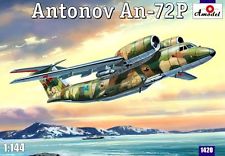
Antonov's Jet Twins. From the Webmaster. This is the kind
of plane that we now fly to the North Pole. It is real interesting
because the engines are on top, above the center of gravity. I
asked the pilot about if there was any pitch down when giving it the gas
and he said that on landing approach, if you are not very experienced
with this kind of airplane, you can definitely stick the nose into the
ice. I'm a super lucky person because I get to visit the cockpit
on the flight. It's like flying on another planet when you are
looking out over the pole. |
|
Here to see the Exhibit on Arctic Russian Aircraft.
|
The Remainder of the Story. |
|
It was like looking down to a lower level while sitting
in a theater. The other expedition group was a dog sled expedition and
they had their equipment and dogs with them. These were some of the bigger
dog led dogs that I have normally seen. It was really interesting because
the dogs wanted to roam around and see everyone. They walked on top of
many people just to get to see other people. These were really nice dogs
and it was a good experience to have them come and visit.
I'm just guessing, but it seemed like about four hours before we came to Khatanga. The sun was still up because it never goes down at this time of the year, but the storm was so bad that it was almost totally black outside. The plane swayed back and forth as the pilot kept realigning his flight path for the ILS approach to the runway as he compensated for the high wind gust. It was a little bit scary and everybody was holding on to something. However, we landed without a problem. When we got out of the plane it was really cold, much colder than my equipment was capable of withstanding. Everyone looked back and forth to each other and said, "Lets go back to the North Pole to get warm." My fingers were really cold really fast and I had to pull them into the palm of my outside glove to keep them warm. My boots were rated down to -45 degrees and they were not warm enough. There was a light snow blowing and the sky was jet black. I have the picture in my photo album, but somehow it didn't scanned in, possibly because it was just too dark and I didn't think it would look good on the site. If you would like to see the actual planes in 2002 North Pole Expedition Exhibit, just Here. |
|
Out of Print Books |
| Antonov's Heavy Transports. Red Star Vol.18 Big Lifters for War and Peace. Gordon & Komissarov. This book examines Russia's amazing, mighty transports starting with the An-22 "big lifter" and proceeding on through the An-124 - which boasted a 392-ton takeoff weight and a 120-ton payload - and the 600-ton An-255 Mriya, designed to piggyback components for the Energiya/Buran space transport system. 128 pages, 200 B&W and color photographs, 8 pages of line drawings, 8"x 11", softcover. |
(
) ( Model Airplanes ) (
Tools)
(
)
( ) (
Fighter
Aircraft Books )
Click Here to see great pictures of our expedition through Russia
Please note. The background this page is a picture of the clouds
while we were flying across Siberia on the way to the
North Pole
Look at these exhibits and tell me what these men really fought for.
the 34th fighter Squadron
USS Kitty Hawk
About the Webmaster, Why God Send Me to the North Pole
Click here to see how I have to live and what it looks like to be
a disabled Vet.


Models_Fighters/D_Russian_Antonov_Aircraft
Copyright Dates:
12-5-2008 11-19-2010 06-21-2015
| . |
