Sopwith Aircraft Books, Sopwith Camel, Sopwith Pup and
Triplane World War 1 Fighter.
You are in the Sopwith
Camel World War 1 Aircraft section.of
the WW1 Aircraft Books Department.
in
the
YellowAirplane
store.
One of the most well
know planes of World War 1 was the Sopwith Camel, a new type of World War
1 weapon is here today for your airplane model collection. Includes the Sopwith
Pup and Triplane Models.
The Sopwith Camel was perhaps the best Allied fighter of
WWI, successfully downing 1,924 aircraft in only 16 months of fighting. It
was known for being extremely agile and for having a fast rate of climb,
and perhaps most notably, the great Baron von Richthofen fell to the guns
of a 209 Squadron RAF Camel flown by Canadian Roy Brown in 1918. The aviation art section
has some great World War 1 photos and other images. Building
and owning these aircraft will give anyone a good picture of world war
1 history. Sopwith also was famous for the
Sopwith Pup and the British Sopwith Triplane.
These Sopwith model airplanes come in 1/20, 1/24, 1/32,
1/48 and 1/72 Scale Pre Built Diecast and Mahogany Display Models and Balsa Wood
and Plastic Model Kits.
0015191 Pure Luck
Hardbound Book
0015191
The Authorised Biography of Sir Thomas Sopwith
Bramson. This book traces the remarkable story of Sir Thomas Sopwith, a
contemporary of the Wright Brothers whose 101-year life spanned aviation
history. You'll read of his Camel and Pup that revolutionized aerial combat in
WWI; of his Hurricane and Lancaster, which were amongst the most successful
designs of WWII; and of the remarkable Harrier "jump jet," which emerged from an
industrial empire that employed up to 127,000 people. 288 pages, 98 B&W
photographs, 6"x 9", hardcover.
#0015191
3
Camel Drivers0001388320" align="left">
0001388 Camel Drivers
Hardbound Book
0001388
The 17th Aero Squadron in World War I. Reed & Roland. The 17th Aero Squadron
flew Sopwith Camels under British command along the Western Front during the
summer of 1918. This definitive work on the unit is drawn from a wide range of
official and personal sources, including original squadron records (found in an
attic!), numerous interviews, letters written home, and half a dozen diaries -
including one kept by a German pilot flying in opposition. 160 pgs., 200+ B&W
photos, 8"x 11", hdbd.
#0001388
4
0015454 Sopwith Camel vs. Fokker Dr.I
Soft Bound Book.
Western Front 1917-18
Guttman. Through firsthand accounts and innovative cockpit-view artwork, this
heavily illustrated book examines the legendary World War I dogfights between
the Sopwith Camel and the Fokker Dr.I - a pair of highly maneuverable,
rotary-powered fighters that were evenly matched in close quarters - while also
exploring the planes' design and development and successes and failures. 80
pages, B&W photographs and color illustrations, 7"x 9", softcover.
#0015454
1
Dolphin & Snipe Aces of WWI0006230338" align="left">
0006230 Dolphin & Snipe Aces of WWI
Aircraft of the Aces Vol. 48 Softbound Book
0006230
Franks. The last of the famous Sopwith fighters to enter service during
WWI, the Dolphin and the Snipe built on the strong scouting heritage of the Pup
and Camel. The Dolphin, a heavily-armed, negative-staggered-wing biplane,
provided the pilot with the best possible tactical view for seeking the enemy.
The Snipe succeeded the Camel in August 1918 and proved its superiority over
virtually all other fighters. 96 pgs., 107 B&W photos, 44 color profiles and
more. 7"x 9", sfbd.
#0006230
2
Sopwith Aviation Company" 32"0005304border="1" vspace="4" hspace="10" width="250" height="355" align="left">0005304 Sopwith
Aviation Company
Images of Aviation
Hall. A young man in his early twenties, Tommy Sopwith found himself the head of
the Sopwith Aviation Company, producing thousands of Britain's best warplanes -
including the Sopwith Camel, credited with destroying more enemy planes than any
other fighter of WWI. This is a visual history of those amazing ten years of
Sopwith, from 1910-1920. 128 pgs., 200 B&W photos, 6"x 9", sfbd.
#0005304
Sopwith Triplane Aces of World War 1" 33"0015178border="1" vspace="4" hspace="10" width="250" height="340" align="left">0015178 Sopwith
Triplane Aces of World War 1
Aircraft of the Aces Vol. 62
Franks. The inspiration for the iconic Fokker Dr.I, the Sopwith triplane boasted
a massive wing area giving it an unmatched rate of climb and improved
maneuverability. When it made its combat debut in late 1916, the triplane could
easily out-fight any other aircraft on either side. Here, you'll see the
groundbreaking aircraft and meet the aces through photos, firsthand accounts and
more. 96 pgs., 97 B&W photos, 45 color profiles, 7"x 9", sfbd.
#0015178
2
Naval Aces of World War 1: Part 1" 30"0015072border="1" vspace="4" hspace="10" width="250" height="340" align="left">
0015072 Naval Aces of World War 1: Part 1
Aircraft of the Aces Vol. 97
Guttman. Filled with firsthand accounts, rare archival photographs and
full-color artwork, this volume examines all of the Royal Naval Air Service (RNAS)
pilots who - flying aircraft such as the Sopwith Pup, Triplane and Camel -
achieved ace status in World War I. You'll read about Raymond Collishaw (60
victories), Robert A. Little (47), Roderic Stanley Dallas (32) and many others.
96 pages, B&W photographs and color illustrations, 7"x 9", softcover.
#0015072
2
0006380 Sopwith Camel Aces of World War 1
Aircraft of the Aces Vol. 52 Softbound Book
0006380
Sopwith Camel Aces of World War 1
Aircraft of the Aces Vol. 52
Franks. The Camel was the most successful fighting scout employed by either side
in WWI, responsible for destroying 1,294 enemy aircraft. Requiring highly
skilled pilots, many pilots were lost learning to fly the nimble aircraft. This
book covers the Camel in combat on the Western Front, in Palestine, on the
Italian front, in the Home Defense role in the UK and in Russia. 96 pages, 90
B&W photographs, 48 color profiles, 3-views and more. 7"x 9", softcover.
#0006380
2
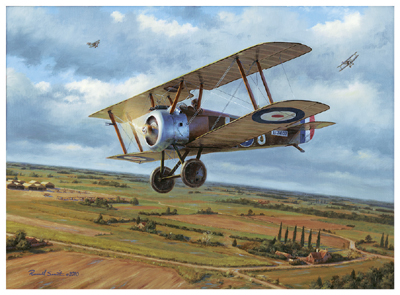
0070476 Clairmarais Camel
Aviation Art
Russell Smith. Returning from a ground attack mission, a Sopwith Camel makes its
approach to Clairmarais aerodrome on April 23, 1918. 17"x 13" print is signed
by the artist.
#0070476
2
A History of No. 10 Squadron Royal Naval Air Service in WWI0021002323" align="left">
0021002 A History of No. 10 Squadron Royal Naval Air Service in WWI
Hardbound Book
Sopwith Triplanes and Sopwith Camels
0021002
Westrop. No.10 Squadron was formed in February 1917 as part of the rapid naval
aviation expansion program on the Western Front. This book provides a detailed
history of this squadron's activities, combat claims, accidents and fatalities,
aircraft (Sopwith Triplanes and Camels) and markings, pilots, and ground
officers. 200 pages, 100 B&W photographs, 32 color profiles, 8"x 11",
hardcover.
#0021002
Sopwith Pup Aces of World War I0015366337" align="left">
0015366
Sopwith Pup Aces
0015366
of World War I
Aircraft of the Aces Vol. 67 Softbound Book
0015366
Franks. In this book, you'll learn of the combat careers and tactics of the
pilots who made ace flying the Sopwith Pup, the first proper British fighting
scout that - though achieving much success after it arrived on the Western front
in 1916 - saw its final combat at the end of 1917 when it ceded the skies to the
even more famous and successful Sopwith Camel. 96 pages, 80 B&W photographs, 20
color profiles, 7"x 9", softcover.
#0015366 2
British & Allied Aircraft Manufacturers of the First World" 29"0036242border="1" vspace="4" hspace="10" width="250" height="361" align="left">0036242 British
& Allied Aircraft Manufacturers of the First World
War
Treadwell. This heavily illustrated book examines the various aircraft types
flown by the Allies during World War I, describing each aircraft and its
manufacturer in detail. You get information about the the Sopwith Pup and Camel,
Bristol F.2B, the huge Handley Page O/400 bomber, Vickers Vimy, Martinsyde
G.100, Avro 504 and others. 256 pages, 152 B&W photographs and illustrations,
7"x 10", softcover.
#0036242
2
Book of Airmen's Obituaries" 28"0036107border="1" vspace="4" hspace="10" width="250" height="408" align="left">0036107 Book
of Airmen's Obituaries
The Daily Telegraph
Bishop, ed. This fascinating book presents 100 biographies - based on obituaries
that have appeared in the London Daily Telegraph - of outstanding aviators of
the last century.
You'll read about R.E. Bishop, who designed the de Havilland Mosquito; Tom
Sopwith, the pioneer plane maker; Sir Frank Whittle, the father of jet
propulsion; legendary pilots Jeffrey Quill, Bob Stanford Tuck, Ginger Lacey,
Adolf Galland, Johnnie Johnson, Babe Learoyd and Peter Townsend; Monique
Agazarian, an Air Transport Auxiliary pilot who on VE day flew the length of
Piccadilly at low level in a Spitfire; and many others. 512 pages, 5"x 8",
hardcover.
#0036107
Holmes. Planning on doing a bit of plane spotting? Well, this guide provides you
with technical information and accurate color profiles of 70 of the world's most
iconic aircraft - including the Sopwith Camel, Messerschmitt Bf 109, P-51
Mustang, B-52 Stratofortress, F-16 Fighting Falcon, and more - to help you make
identifications while on your adventure! 216 pages, 70 color illustrations, 7"x
5", softcover. #0015092 1
Aircraft of World War I, 1914-1918" 27"0036183border="1" vspace="4" hspace="10" width="250" height="316" align="left">0036183 Aircraft
of World War I, 1914-1918
The Essential Aircraft Identification Guide
Herris & Pearson. Illustrated with detailed artworks of combat aircraft and
their markings, this book is a comprehensive study of the planes that fought in
World War I. You'll view numerous variations and types of well-known models such
as the Fokker Dr.I, the Sopwith Camel and the SPAD VII as well as lesser-known
aircraft such as the Rumpler C.1 and the Amstrong Whitworth FK8. 192 pages, 200
color and B&W photographs and illustrations, 7"x 9", hardcover.
#0036183
3
0005277 British Aircraft Before the Great War
WWI
Mike Goodall. For the first time, the history of British pre-WWI aircraft has
been gathered together in one volume, with more than 900 of them well
illustrated. This most valuable contribution about a remarkable period in
aviation history is a memorial to the bravery and inventiveness of the intrepid
pioneers of that far off era. Includes Avro, Sopwith, Shorts, and Bristol, as
well as lesser-known designers and builders. 300 pgs., 930 B&W photos, 8"x 11",
hdbd.
#0005277
British and Empire Aces of WWI0006168vspace="4" border="1" width="150" height="202" align="left">
British and Empire Aces of WWI
Aircraft of the Aces Vol. 45
British and Empire Aces of
World War I, Shores. While the Allies and their adversaries raced to outdo each
other in the creation of genuinely effective fighters in WWI, it was not until
1917 that the British developed a truly effective interrupter gear, paving the
way for the Sopwith Camel, S.E.5 and Bristol F.2B. In this book, you'll
trace the rapid development of the fighter in WWI, and follow the exploits of
the aces who flew them. 96 pgs., 100 B&W photos, 36 color profiles and more,
7"x 9", sfbd.
Sopwith Fighters in Action0004150vspace="4" border="1" width="150" height="112" align="left">
Sopwith Fighters in Action
Peter Cooksley. The family of
Sopwith fighters served England, France and the U.S. throughout World War I,
with the 1 Strutter, the Pup, the Camel the Snipe and others becoming classics
of the period. This review of the evolution of Sopwith fighters and their
performance in combat contains 95 photos, dozens of detail drawings, 10 color
profiles and more. 49 pages, 11"x 8", softcover.
50 Aircraft that Changed the World0020986vspace="4" border="1" width="150" height="150" align="left">
50 Aircraft that Changed the World
Dick & Patterson. This wonderfully illustrated book
presents a close-up survey of 50 of the most remarkable and influential
aircraft in history, including the Wright Brothers' 1905 Flyer, the Sopwith
Camel, Amelia Earhart's Lockheed Vega, the Bf 109, the Boeing B-17, the De
Havilland Mosquito, Howard Hughes' Lockheed Constellation, the Concorde, the
Learjet, the B-52 and many others! 208 pages, 300 color and B&W photographs,
11"x 11", hardcover.
The
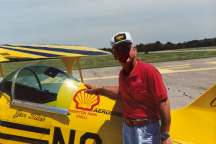
First Certificated Pitts Jim Klick and Worlds First Certificated Pitts Aerobatic Airplane.
Great photos and Computer Graphics.
Aircraft
: Sopwith Camel MANUFACTURER : Sopwith Aviation Co. Ltd.
Year
: 1917 Engine
: 1 x "Bently"BR.1 150 hrs. pwr ./ One 130 Clerget 9 cylinder rotary
Wingspan
: 8.50 m 28ft Length
: 5.60 m Weight
: 470 kg/695 kg 1,453 lbs Max. speed :
199 km/h 115mph Ceiling
: 5650 m 19,000 ft Crew
: 1 Armament
: 2 x machineguns
Sopwith Aircraft Research Notes:
Sir Thomas Sopwith
a contemporary of the Wright Brothers whose 101-year life spanned aviation
history. You'll read of his Camel and Pup that revolutionized aerial combat in
WWI; of his Hurricane and Lancaster, which were amongst the most successful
designs of WWII; and of the remarkable Harrier "jump jet," which emerged from an
industrial empire that employed up to 127,000 people.
The Camel was perhaps the best Allied fighter of WWI, successfully downing
1,924 aircraft in only 16 months of fighting. It was known for being
extremely agile and for having a fast rate of climb, and perhaps most
notably, the great Baron von Richthofen fell to the guns of a 209 Squadron
RAF Camel flown by Canadian Roy Brown in 1918.
The Camel had great agility in combat because
of the fantastic torque of its rotary engine and because the engine, pilot
and guns were all located in the first seven feet of the wooden airframe.
No.10 Squadron was formed in February 1917 as part
of the rapid naval aviation expansion program on the Western Front.
Captain Elliot Springs, 16-victory WWI ace and
one of the most colorful American flyers of the war, leads the 148th Aero
Squadron.
British and Empire Aces of World War I, Shores.
While the Allies and their adversaries raced to outdo each other in the creation
of genuinely effective fighters in WWI, it was not until 1917 that the British
developed a truly effective interrupter gear, paving the way for the Sopwith
Camel, S.E.5 and Bristol F.2B.
The 17th Aero Squadron in World War I. Reed &
Roland. The 17th Aero Squadron flew Sopwith Camels under British command along
the Western Front during the summer of 1918.
The last of the famous Sopwith fighters to enter
service during WWI, the Dolphin and the Snipe built on the strong scouting
heritage of the Pup and Camel. The Dolphin, a heavily-armed,
negative-staggered-wing biplane, provided the pilot with the best possible
tactical view for seeking the enemy. The Snipe succeeded the Camel in August
1918 and proved its superiority over virtually all other fighters.
Sopwith Camels, each carrying 250-pound bombs,
take to the skies from HMS Furious - the first dedicated aircraft carrier in the
world - on a raid against the German Zeppelin sheds at Tondern. Carried out on
July 19, 1918, this was the first successful bombing raid ever to be launched
from a carrier.
The Sopwith Camel is widely recognized as the
most successful allied fighter of the Great War. Of the men who flew them
exclusively, one name stands out above the rest - Major Donald R. MacLaren, who
achieved 54 victories, the final nine of which were scored in this machine.
Captain R.A. Little, the RNAS' highest-scoring
ace with a total of 47 victories, achieves one of the 15 attained while flying a
Sopwith Triplane with No. 8 Squadron RNAS between April and July 1917
The Camel was the most successful fighting scout
employed by either side in WWI, responsible for destroying 1,294 enemy aircraft.
Requiring highly skilled pilots, many pilots were lost learning to fly the
nimble aircraft.
The family of Sopwith fighters served England,
France and the U.S. throughout World War I, with the 1 Strutter, the Pup, the
Camel the Snipe and others becoming classics of the period.
Sopwith Pup, the first proper British fighting
scout that - though achieving much success after it arrived on the Western front
in 1916 - saw its final combat at the end of 1917 when it ceded the skies to the
even more famous and successful Sopwith Camel.
Please Note:
I took the photo of the clouds used in the background picture while we were
flying from a Northern Siberian city named Khatanga on our way to
the North Pole in April 2002. C. Jeff Dyrek, webmaster
Yellow Airplane Gives
You the Best Source of Airplane Models, Airplane
Books, Airplane Movies, Aviation Art, Aircraft Calendars, Airplane Tools,
Exhibits and MORE!