 |
|
|
Photos on the North Pole Polar Ice Cap at Barneo Base about 60 miles South of the Pole.
North Pole Expedition 2002.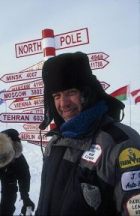
|
Photos on the North Pole Polar Ice Cap at Barneo Base about 60 miles South of the Pole.North Pole Expedition 2002. |
||
|
|
Photos from Barneo Base, the North Pole base camp and the Actual North Pole Page 1. |
| North Pole page 1. |
| North
Pole Expedition 2002,
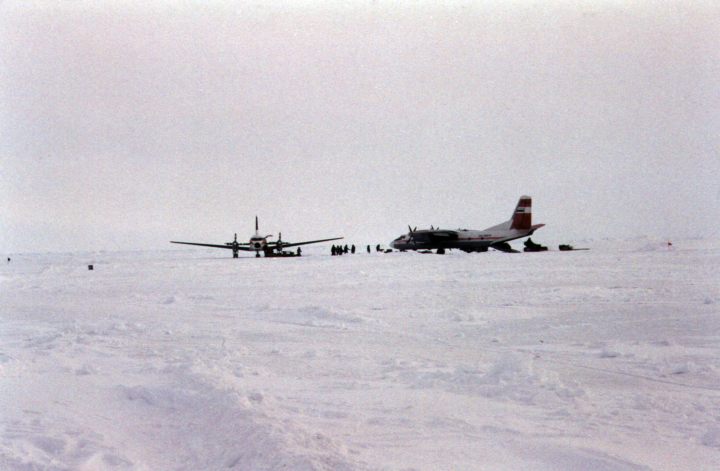
This is our landing zone on the North Pole, actually, Camp Barneo which is located 60 miles from the actual North Pole. The runway here is about 3000 feet long and is cut from solid ice two meters thick floating on top of 12,000 feet of water. |
|
|
| Jet Fighters | WWII Fighters | Adventure Travel | Ships | Spacecraft | Tanks |
 |
 Previous Page
 |
Home Page |
 |
| The temperature here on the North Pole (Cold) but not as cold as you may think. |
This years Expedition consisted of twenty-six members from thirteen countries including: USA, United Kingdom, Hong Kong, France, Poland, Russia, Iran, Ireland, Singapore, Austria, Italy, Brazil and Denmark.
My personal accomplishments were:
Farm Kings North Pole Expedition 2002 returns home Anatomy of an Expedition.
Next, two Mil Mi-8 helicopters fly to the pole following the path of locator beacons to the fuel stops needed for this long trip. One helicopter, using a sling, carries a small dozer under its belly while the other helicopter carries a construction crew, tents, food and survival equipment. Once at the polar base camp, Camp Barneo , which is located only about sixty miles from the pole, the crew lays out and constructs an all ice runway which was, this year, seven feet thick, three thousand feet long, and floating above12,000 feet of water. Following the helicopters is an An-26 twin turboprop cargo plane, fitted with a huge internal fuel tank and the remaining space filled with an additional cargo of tents, survival equipment and fuel for the completion of Camp Barneo . At this time the rest of the expedition members are ready to leave for the pole, but it's still not that simple as you will see. This year we coordinated with the Russian Air Force and a Japanese Expedition Team. The race to the pole was on. Once that Camp Barneo 's all ice runway was constructed the trick was to see whether the American led expedition or the Japanese expedition would be the first to reach the pole. We pulled some strings and, without a doubt, would beat the Japanese team by several days. Instead of first flying to Khatanga, in Northern Siberia, where the expedition usually starts, we charted a Russian Air Force An-74 STOL (Short Take Off and Landing) jet for a flight to Spitsbergen and to Franz Josef Land for an early arrival on the pole. Mother Nature a force to be reckoned with.
We took the bus from our hotel in Moscow and headed for the airport, not knowing, at this time, that our An-74 was still stranded for the third day. We pulled into the back gate of the airport in Moscow, had our supplies and luggage weighed and waited for three hours before we found out that our charter aircraft would never arrive. It was a mad rush to the airport terminal where we boarded a Tupolev Tu-134 civilian jet airliner, now, headed for Khatanga which was our original plan. The cyclone was moving eastward and closed the Khatanga Airport before we could arrive which diverted our aircraft to Norilsk. Norilsk is a frozen city deep in Siberia, far north of the Arctic Circle, covered in snow ten month out of the year. We stayed there overnight, ILLEGALLY! Norilsk is a closed territory and unless a person has a written invitation from someone in that city, they are not allowed visit. We, as foreigners, were not allowed to even stay in the airport hotel, so our Russian guide, to keep us from going to jail, signed into the hotel as a Russian Citizen with 25 guest. We sent ahead for an Antonov An-24 Turboprop when the Khatanga airport again reopened for the continuation of our flight. Our race was still on. The Japanese Team also had many weather problems but arrived in Khatanga a few hours before us. We still had a chance to beat the Japanese to the pole. The advantage that we now had was that our Russian liaison has worked with the Air Force officers for many years, previous to this expedition, and they were personal friends. New cyclones were forming and there was a small window of opportunity to have all three airports at Camp Barneo , Sredney Island and Khatanga open at the same time. This was necessary for the safety of having the origination and final destination airports plus an alternate landing zone. Unfortunately, we found out that one of our members had a Visa problem which must be cleared before the entire American Team could leave, so, the Japanese Team left for Camp Barneo and had beat us to the pole. The weather became very bad. The snow was blowing with heavy winds. Visibility went to zero feet and temperatures dropped below -15 degrees in Khatanga. After two days another window of opportunity opened up but we had more bad news. The all ice runway at Camp Barneo cracked for the second time and needed to be extended over more good ice before an airplane could be landed there. A crack in a floating ice runway is not like a crack in a concrete runway. When a ice runway cracks it has two possibilities, it opens up leaving a large expanse of open water called a "lead" or it pushes together with great force in a pressure ridge pushing up very large chunks of ice high into the air. When the ice opens up, the airplanes, tents and everything else have a chance of falling into the frigid Arctic waters. On the other hand, when a pressure ridge forms, large walls of ice are pushed up into the air making very long barriers which would crush an aircraft that was trying to land. We continued to wait through the next cyclone spiral arm and more bad weather. After the sky finally cleared up we were still stranded because the wind conditions and drifting snow at Sredney Island kept the airport closed. Their snow removal truck broke down and needed to be repaired before the runways could be cleared. The Psychology of Stranded People.
The Expedition, finally, makes its move.
Twelve hours later, the An-26 was back and after refueling it was our turn to head for Camp Barneo . This An-26 had a very large internal auxiliary tank installed to give it the extra needed range, so we were crammed into the remaining space with all of our equipment. After being packed into the cabin on Sredney Island and now being crammed into a small cargo hold of a tightly packed plane, we have some suggestions for the sardine packing companies. We reached Camp Barneo , and almost immediately, we boarded the Mi-8 helicopter and headed for the real North Pole, picked up some of our skiers, dropped our skydivers and had a photo session and champagne. The time was 2:15 p.m. on April 29th CST. Because of the late date and the necessary return to work by many of our members, our time was limited, so an immediate return to Khatanga was necessary to catch the once a week commercial flight from Khatanga to Moscow. I noted on first landing at Barneo , that a new runway crack has formed with the height difference between the plates of ice being about one half of an inch. Several hours later, just before we left Barneo , the height difference of the plates was just under six inches. The ice, this year, was thinner than on previous years and leaving the heavy aircraft on the ice in combination with the oceans turbulence from the cyclones was making the runway very unstable and there was very much danger of further cracks that could leave us totally stranded. We were on the way back and I had a great view out of the window of the plane as we flew over the Arctic Ocean. The pressure ridges and leads (cracks) in the polar ice cap were incredibly beautiful. The Arctic wind, blowing ice particles around the surface, looked like steam rising from the ice. All I can say is that the view was incredible and no photo or description could describe this picture or experience. Our plane stopped at Sredney island where we went back to that little room and waited for another six hours. This time there was already another group of explorers there making conditions even tighter. We also had one very sick gentleman , Bill, who needed emergency medical treatment. Luckily, there was a very good doctor on Sredney, at this time, and he was able to give assistance with the help of Mikhail Rybochkin, our Russian guide, as a translator. Our next plane was refueled and ready for departure. Along with the other explorers and their dog teams we next boarded the An-12 and headed for Khatanga. Even though this plane was much larger than the An-26, by the time we loaded the dog teams, their sledges and equipment, we were again crammed into another cargo hold, this time, however, the cargo hold had no pressurization. People were laying on top of all kinds of equipment anywhere they could sit or lay down. The dogs were restless and wandered over and stepped on everyone as they roamed the interior of the plane. I was very lucky because I was laying on top a stack of metal tubing in a very comfortable position. We taxied to the end of the runway and as the four massive engines went to full power, all of the cargo shifted toward the back of the plane. Now, instead of having a very comfortable spot to lay, The metal tubing shifted and my feet have suddenly moved above my head and it was very uncomfortable making it necessary for me to find another spot. Toward the end of the flight, at Khatanga, the weather was very bad with heavy cross winds and near zero visibility. I could feel the pilot make many corrections as he lined the plane up for final approach to the runway. Finally we touched down and the pilot applied full reverse thrust to stop this heavy aircraft on the ice covered strip. As we came to a stop we noticed that it was very dark outside and this was notable, because in Khatanga, in early May, the sun never sets. This was a good indication of how thick the clouds really were. As we unloaded the plane we noticed that it was extremely cold. The temperature was minus twenty eight degrees Fahrenheit with wind chills nearing minus seventy degrees. My Thinsulate gloves were almost like having no protection at all and my fingers were instantly frozen to the point that I had to pull them out of the fingers of the gloves and make a fist to keep them warm. Thinking about how nice it was at the North Pole where the wind was near zero miles per hour and temperature was at a warm minus twenty three degrees, a person leaned over to me and said, "Lets go back to the pole to warm up!" A Summary of the Expedition.
There was one day, however, that I was very cold and shivered badly for more an hour. That was the day that I returned home to western Illinois, the heat was off for three weeks and the temperature was in the lower forties. I jumped into a cold bed and had my single arctic freezing experience. When you go on an arctic adventure, you are dressed with EXP Extreme Exposure Protection gear, so you may get cool, but never freeze. When you are in the mid spring Illinois, you expect to be warm so you don't dress for these conditions, and surprise, you feel the extreme chills. Luckily, I was able to purchase all of my equipment, including boots that were rated at -60 degrees, at the Farm King stores. Again, no description or photos could describe this trip, you had to have been there to see it for yourself. One question that I have been asked repeatedly is, "Why do you want to go to the North Pole?" Other than the obvious answer of, "Because it's there," it's really an exercise in focus. If you concentrate on something nearly every day, look at it and talk about it, it will come true. As the great motivational speaker, Napoleon Hill once said, "Anything a man can conceive and believe, he can achieve." This is just a test of this statement and it's true. Besides, this trip was literally fantastic, to boot. Anyone can view a complete summary of photos by visiting .. and pressing the North Pole Summary link. You can also contact me there to join our next expedition adventure to the North Pole starting April 15th 2003. I am giving some real nice seminars and slide shows on North Pole travel to schools and other clubs and organizations. If you would like to have one of these seminars for your group, please send an email to jeff@YellowAirplane.com C. Jeff Dyrek, webmaster
Hindsight. Written 29
Dec. 2007 Looking back at this entire expedition and exhibit, plus
the experience that I have gained on later expeditions I found out that this was
not the Russian Air Force that assisted us. Others called the planes the
Khatanga Airlines, which I found out from Russians that are living in Khatanga
never existed as a company. Instead, the these planes were
chartered by the expedition operators. Also, earlier expeditions through
Khatanga did fly in planes that took off from the Air Force Base in Moscow.
|
Click Here for a list of WW2 Fighter Groups
Click Here to go to the YellowAirplane Online Museum
Look at these exhibits and tell me what these men really fought for.
The 34th Fighter SquadronThe 34th fighter Squadron
WW2 Exhibit
USS Kitty Hawk Aircraft Carrier Exhibit.
About the Webmaster, Why God Send Me to the North Pole
/North_Pole_2002/On_the_North_Pole_1.html|21835"
| . |

