|
After serving 10 years in Soviet prison camps following World War II,
Erich "Bubi" Hartmann - the highest scoring ace in history with 352 victories -
returned to Germany and became commander of the West German Air Force's first
all-jet unit: JG 71 "Richthofen." Sabre swept-wing Jet Figther
flown by 234 Squadron of the 2nd Tactical Air Force based at RAF Gelenkirchen,
Germany, in 1954
Beauteous Butch II - an F-86F-30 Sabre flown by Capt. Joseph McConnell,
who became America's top-scoring jet ace when he shot down 16 MiG-15s during the
Korean War - as it was repainted following McConnell's final mission
"The Huff," the dragon-wearing F-86F Sabre flown by Lt. James Thompson of
the 51st Fighter-Interceptor Wing; the 8th Fighter-Bomber Wing's commander's
aircraft; the Belgian Air Force, 1955; and the Italian Air Force, 1958)
"Mike's Bird," an F-86F flown by Captain Charles McSwain of the 39th
Fighter-Interceptor Squadron, 51st Fighter-Interceptor Wing, stationed at Suwon
Air Base, South Korea, in 1953
"Billie/Margie," the F-86F flown by 10-victory ace Capt. Lonnie Moore of
the 335th Fighter-Interceptor Squadron, 4th Fighter-Interceptor Wing, in July,
1953
The F-86F flown by 16-victory ace Maj. James "Jabby" Jabara - who, as the
first American jet ace, shot down fifteen MiG-15s (after scoring 1 victories in
World War II) to rank as the second-highest scoring U.S. ace of the Korean War -
of the 334th Fighter-Interceptor Squadron, 4th Fighter-Interceptor Wing, in
July, 1953
Best known for its service in the Korean War where it was pitted against
the Soviet MiG-15, the F-86 Sabre was by far the most-produced Western jet
fighter with 9,860 units built. "The Huff," the F-86F flown by 51st
Fighter-Interceptor Wing pilot Lt. James Thompson, who chose the colorful paint
scheme after downing a MiG-15 with a dragon painted on its side.
75th Fighter-Interceptor Squadron "Tiger Sharks," 519th Air Defense Group
In 1948, intelligence warnings prompted the U.S. Air Force to hurriedly
develop an all-weather interceptor. Starting with the basic airframe of its
F-86A Sabre, North American incorporated two unprecedented concepts into the
F-86D (initially designated the F-95): a highly sophisticated electronic system
replaced the second crewmember carried by other interceptors and air-to-air
missiles replaced the classic gun armament. F-86D flown by the 357th
Fighter-Interceptor Squadron out of Nouasseur Air Base in French Morocco in the
late 1950s.
F-86D Sabre Dog 1/72 Yugoslav Air Force
Wham Bam, an F-86A Sabre flown by the 336th Fighter-Interceptor Squadron "Rocketeers,"
4th Fighter-Interceptor Wing (the top MiG-killing wing of the Korean War)
After serving 10 years in Soviet prison camps following World War II,
Erich "Bubi" Hartmann - the highest scoring ace in history with 352 victories -
returned to Germany and became commander of the West German Air Force's first
all-jet unit: JG 71 "Richthofen." Sabre swept-wing fighter jet flown by 3./JG 71
in 1963
Miss Jane, an F-86 Sabre flown by the
311th Fighter-Bomber Squadron
stationed at Osan Air Base, Korea, in 1958
Col. Francis Gabreski is shown here bagging one of the 6½
MiGs that he added to his total of 24 confirmed victories in Europe during
WWII.
The frosty morning air is shattered by a hunting party of F-86 Sabres
of the U.S. 51st Fighter-Interceptor Wing,
led by Gabby Gabreski, as they
blast off the runway at Kimpo airfield, South Korea.
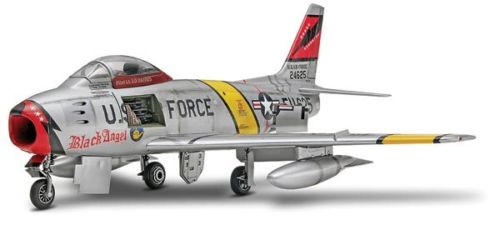
This
is a highly detailed plastic kit of the F-86 variant with lengthened "6-3"
swept-wings that saw extensive use during the Korean War against the
MIG-15.
North American F-86F Sabre, "Beautious Butch,"
flown by America's top scoring Korean War ace,
Captain Joseph M. McConnell, Jr.,
39th FIS, K-13,
May 1953.
Korean War aces
Major General Federick C. Blesse,
Brigadier General Robinson Risner, Colonel
Harold E. Fischer and
Colonel Ralph
S. Parr.
Sabre Dog series explores the F-86s of the U.S.
Air National Guard as well as those in foreign service around the world.
Canadair Sabre flown by the
German Luftwaffe in
1954
Canadair Sabre flown by
352-victory ace
Col. Erich Hartmann of
JG 71 Richthofen, West German Air Force,
during the Cold War 1961
markings including Hartmann's trademark spreading black tulip nose art.
The Battle of Carlson's Canyon,
The Life Story of the World's Highest Scoring Ace
Jager. With 352 aerial victories and ten years in a Soviet prison, Erich
Hartmann survived uprisings, hunger strikes, and forced labor. His will to do
his duty was remarkable - after being released, he was still mentally and
physically fit enough to fly F-86 jet fighters in
the post-World War II German Air Force. This photo album presents the different
stages of his life - a man who wished to become a doctor, but whose fate it was
to become and remain a soldier.
USAF pilot Lt. Joseph M. McConnell Jr.'s Sabre,
"Beautious
Butch II," as he flew it for the 39th Fighter-Interceptor Squadron / 51st
Fighter-Interceptor Wing.
The CL-13 (F-86) flown by "Ace of Aces" Col.
Erich Hartmann leads the first all-jet fighter wing - JG 71
Richthofen, whose
aircraft all sport the spreading black tulip nose art that was Hartmann's
personal emblem throughout World War II - of the West German Air Force on a 1961
mission.
America's Air Force Celebrates 100 Years of Aviation. Hildebrandt.
Assembled by the USAF to celebrate the 100th anniversary of powered flight, this
unique demonstration team pairs military pilots in the
latest aircraft with
civilian pilots in classic Warbirds for breathtaking formation flight.
Outstanding air-to-air photography captures
F-16 Falcons,
F-15 Eagles and
A-10
Warthogs in concert with a
C-130,
B-25, F-86 and others.
Wearing what were perhaps the largest shark's
teeth markings of the Korean War, this F-86F was flown by Joseph Fields of the
4th Fighter-Interceptor Wing in 1953.
1950s jet fighter. A truly great platform, the
F-86 evolved into an all-weather interceptor, an atomic-capable fighter-bomber,
a carrier-based naval plane, a trainer, and much more. Documented here are the
XP-86 through the "L" variants.
"Beautious Butch,"
the F-86 flown by America's
top scoring Korean War ace, Captain Joseph M. McConnell.
The 116th Fighter-Interceptor Squadron, which was
the first to be based in Europe with F-86s.
The F-86D Sabre Dog, the military all-weather,
radar-equipped variant of the U.S. Air Force's early Cold War frontline jet
fighter.
Angel Face and the Babes flown by
USAF pilot Col.
Royal Baker - who achieved ace status during the Korean War - of the 336th FIS,
4th FIW
F-86E flown by
U.S. Air Force ace Capt. Clifford Jolley, who served with the
335th Fighter-Interceptor Squadron, 4th
Fighter-Interceptor Wing in Korea.
Mitch's Squitch, the F-86 piloted by 51st
Fighter-Interceptor Wing commander Col. John Mitchell, who shot down four MiGs
over Korea but who gained even more fame as the leader of the World War II
mission that shot down Admiral Yamamoto.
The 4th
Fighter Interceptor Wing (FIW) was sent
to Korea in December 1950 expressly to face the threat posed by the all-new
MiG-15 fighter that had made its combat debut the previous month. It remained
the sole Sabre wing in-theater for a full year, its pilots tangling with
Russian-flown jets over the Yalu River in "MiG Alley," on a near-daily basis.
Through sheer skill and superior machinery, the 4th FIW prevailed, and the skies
over North Korea remained firmly in U.N. control
On
July 19th, 1953, after his flight of four
F-86s was set upon by 16 MiGs, John Glenn
pursued and "flamed" a MiG to score
the second of his three Korean War kills.
John Glenn's Sabre, "MiG Mad Marine.
This beautifully restored F-86 Sabre, one of the
most pristine Korean-era warbirds flying, is painted with the markings of
USMC (then) Maj. John Glenn, Jr.
of the 51st Fighter Interceptor Wing and
flown by pilot Mike Keenum.
Col.
Walker M. "Bud" Mahurin, who added 3 kills to his World War II tally of
21 while flying in the Korean War.
Mahurin's Honest John markings
from the spring of 1952, when he was Commander of the 4th Fighter Wing;
Featuring the special 1956 "gunnery meet"
markings of a Sabre from the 366th Fighter-Bomber Wing based at
Alexandria AFB, Louisiana,
Painted in the colorful 1956 livery of the
Skyblazers, a USAF demonstration team that performed in Europe from the late
1940s through the late 1950s
The Huff, the F-86 flown by 51st
Fighter-Interceptor Wing pilot Lt. James
Thompson, who chose the colorful paint scheme after downing a MiG-15 with
a dragon painted on its side
Skyblazers poster features the F-86 that the USAF
demonstration team flew in Europe in 1955-56.
Col. Ralph Parr, who earned more than 60
decorations flying over 1,100 hours of combat in World War II, Korea and
Vietnam, this limited edition,
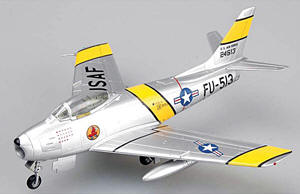
F-86F Sabre 1/72 Model
the F-86F flown by 16-victory ace Maj. James "Jabby" Jabara - who,
as the first American jet ace, shot down fifteen MiG-15s (after scoring 1
victories in World War II) to rank as the second-highest scoring U.S. ace of the
Korean War - of the 334th Fighter-Interceptor Squadron, 4th Fighter-Interceptor
Wing, in July, 1953.
F-86F Sabre
"Mike's Bird," 51st Fighter-Interceptor Wing
"Mike's Bird," an F-86F flown by Captain Charles McSwain of the 39th
Fighter-Interceptor Squadron, 51st Fighter-Interceptor Wing, stationed at Suwon
Air Base, South Korea, in 1953. F-86F
Sabre
Capt. Lonnie Moore, 335th Fighter-Interceptor Squadron
"Billie/Margie," the F-86F flown by 10-victory ace Capt. Lonnie
Moore of the 335th Fighter-Interceptor Squadron, 4th Fighter-Interceptor Wing,
in July, 1953.
F-86F Sabre
"The Huff," 51st FIW, Lt. James Thompson
Best known for its service in the Korean War where it was pitted against the
Soviet MiG-15, the F-86 Sabre was by far the most-produced Western jet fighter
with 9,860 units built.
"The Huff," the F-86F flown by 51st Fighter-Interceptor Wing pilot Lt. James
Thompson, who chose the colorful paint scheme after downing a MiG-15 with a
dragon painted on its side.
F-86D Sabre Dog 1/72 Die Cast Model
No. 343 Interception Squadron, Royal Hellenic Air Force
F-86D Sabre Dog
519th Air Defense Group, 75th FIS "Tiger Sharks," 1953
In 1948, intelligence warnings prompted the U.S. Air Force to hurriedly develop
an all-weather interceptor. Starting with the basic airframe of its F-86A Sabre,
North American incorporated two unprecedented concepts into the F-86D (initially
designated the F-95): a highly sophisticated electronic system replaced the
second crewmember carried by other interceptors and air-to-air missiles replaced
the classic gun armament. the eye-catching
1953 paint scheme of the 75th Fighter-Interceptor Squadron "Tiger Sharks," 519th
Air Defense Group, including the squadron's "Tiger Sharks" emblem on the
fuselage and a shark's mouth on the engine air intake.
F-86D Sabre Dog
357th FIS, Nouasseur Air Base, French Morocco
In 1948, intelligence warnings prompted the U.S. Air Force to hurriedly develop
an all-weather interceptor. Starting with the basic airframe of its F-86A Sabre,
North American incorporated two unprecedented concepts into the F-86D (initially
designated the F-95): a highly sophisticated electronic system replaced the
second crewmember carried by other interceptors and air-to-air missiles replaced
the classic gun armament.
F-86D flown by the 357th Fighter-Interceptor Squadron out of Nouasseur Air
Base in French Morocco in the late 1950s.
F-86D flown by the 357th Fighter-Interceptor Squadron
out of Nouasseur Air Base in French Morocco in the late 1950s.
F-86A Sabre
Wham Bam, an F-86A Sabre flown by the 336th Fighter-Interceptor
Squadron "Rocketeers," 4th Fighter-Interceptor Wing (the top MiG-killing wing of
the Korean War) F-86 Sabre
JG 71 "Richthofen," 1963
After serving 10 years in Soviet prison camps following World War II, Erich "Bubi"
Hartmann - the highest scoring ace in history with 352 victories - returned to
Germany and became commander of the West German Air Force's first all-jet unit:
JG 71 "Richthofen."
Sabre swept-wing fighter jet flown by 3./JG 71 in 1963
F-86 Sabre Miss Jane, an F-86 Sabre flown by the 311th Fighter-Bomber Squadron
stationed at Osan Air Base, Korea, in 1958
F-86D Sabre Dog,
the military all-weather, radar-equipped variant of the U.S. Air Force's early
Cold War frontline jet fighter |