 |
|
|
This is the front page of the
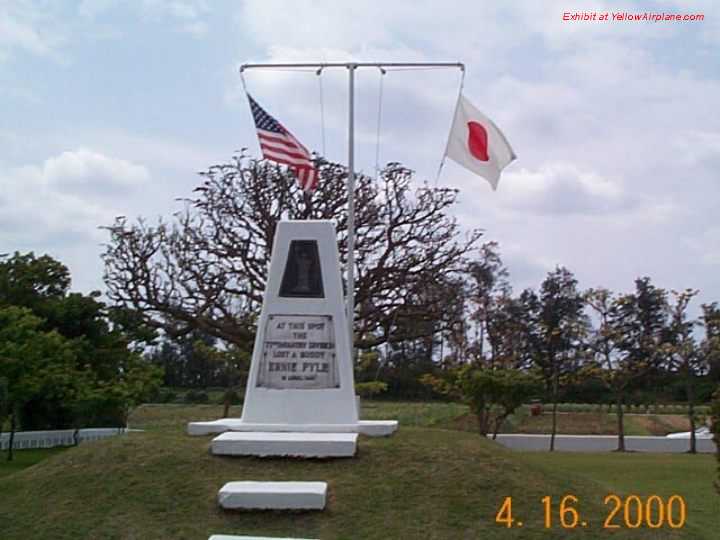
Ernie Pyle Photo Exhibit World War 2.
These are some great photos of Ernie Pyle in World War 2. Ernie Pyle was a
War Correspondent who was loved by many.
Keep looking at this exhibit to find a man who thought that he was the one who
killed Ernie Pyle.
I have a lot more about Ernie Pyle
but it will be some time before I get it on the web so please stand by.
| Jet Fighters | Motorcycles | Sports Cars | Ships | Spacecraft | Tanks | Acoustic Guitars for Sale |
photos donated by
1stLt Andrew J. Lockett, OIC
Operations Support Detachment,
Ie Shima
DSN 622-7333/7380, Fax 622-7380
Use the below as your
main tour guide
If you have any information
or additions to these pages,
please let me know at the bottom
of this page
 |
|
Ernie Pyle Exhibit Home Page |

|
Ernie Pyle was the most famous Combat Photographer / War Correspondent in World War 2.
|
|
|
Take one of these Ie Shima tours You are now in the Ernie Pyle Exhibit. 1st
Fighter Squadron.
|
0700608974
 0700608974Ernie
Pyle's War: America's Eyewitness to World War II (Modern War Studies) 0700608974Ernie
Pyle's War: America's Eyewitness to World War II (Modern War Studies)by James Tobin amazone.com In addition to detailing Pyle's mostly unhappy personal life, Tobin also includes samples of his columns, proving once and for all that Pyle was more than just a hick who fell into reporting; the man had real, substantial talent, evidenced by his ability to put words together and his sensitivity to the subjects he wrote about. More than just a biography, Ernie Pyle's War is also a study of war, and the peculiar, twilight world of suffering and half-told truths to which men like Ernie Pyle were drawn. --This text refers to the Hardcover edition. When a machine-gun bullet ended the life of war correspondent Ernie Pyle in the final days of World War II, Americans mourned him in the same breath as they mourned Franklin Roosevelt. To millions, the loss of this American folk hero seemed nearly as great as the loss of the wartime president. If the hidden horrors and valor of combat persist at all in the public mind, it is because of those writers who watched it and recorded it in the faith that war is too important to be confined to the private memories of the warriors. Above all these writers, Ernie Pyle towered as a giant. Through his words and his compassion, Americans everywhere gleaned their understanding of what they came to call "The Good War." Pyle walked a troubled path to fame. Though insecure and anxious, he created a carefree and kindly public image in his popular prewar column -- all the while struggling with inner demons and a tortured marriage. War, in fact, offered Pyle an escape hatch from his own personal hell. It also offered him a subject precisely suited to his talent -- a shrewd understanding of human nature, an unmatched eye for detail, a profound capacity to identify with the suffering soldiers whom he adopted as his own, and a plain yet poetic style reminiscent of Mark Twain and Will Rogers. These he brought to bear on the Battle of Britain and all the great American campaigns of the war -- North Africa, Sicily, Italy, D-Day and Normandy, the liberation of Paris, and finally Okinawa, where he felt compelled to go because of his enormous public stature despite premonitions of death. In this immensely engrossing biography, affectionate yet critical, journalist and historian James Tobin does an Ernie Pyle job on Ernie Pyle, evoking perfectly the life and labors of this strange, frail, bald little man whose love/hate relationship to war mirrors our own. Based on dozens of interviews and copious research in little-known archives, Ernie Pyle's War is a self-effacing tour de force. To read it is to know Ernie Pyle, and most of all, to know his war. "If you think Ernie Pyle is ancient history, think again. Barely half a century ago he was one of the most famous people in America. The columns he wrote were read by millions, anticipated and revered as though they were regular bulletins from a sacred source. . . . What he called his 'worm's-eye' view of combat set a standard for war reporting that remains influential unto this day. . . . A thorough, sympathetic, and revealing book."--Jonathan Yardley, Washington Post Book World "A portrait of a complex, enormously gifted but tortured writer, entrapped and ultimately driven to death by a sense of obligation to the image he inadvertently created of himself. It is undoubtedly the best biography of Ernie Pyle ever written, but it is much more; few books about combat journalism have so vividly depicted the fascinating interactions between war correspondents and the folks back home. . . . World War II was quintessentially Ernie Pyle's war, and Tobin brilliantly explains why."--Malcolm W. Browne, New York Times Book Review "A fine and fascinating new biography. Pyle didn't write about warriors and generals and lofty subjects like global affairs. He produced wonderful stories about plumbers and teachers and mechanics and all sorts of regular guys who, due to circumstances they had no control over, went to war and then did their best to win and come home alive."--Daniel LeDuc, Philadelphia Inquirer "A wonderfully crafted biography."--William Prochnau, author of Once Upon a Distant War "Ernie Pyle showed everybody else the way. He was a hell of a reporter."--Charles Kuralt About the AuthorJames Tobin, a Pulitzer Prize nominee and prizewinning reporter for the Detroit News, lives in Ann Arbor, Michigan. This is the portrait of a complex, enormously gifted but tortured writer ... It is undoubtedly the best biography of Ernie Pyle ever written, but it is much more; few books about combat journalism have so vividly depicted the fascinating interactions between war correspondents, soldiers, and the folks back home. |
| Ernie Pyle Links
Some
Articles Written by Ernie Pyle The following articles were clipped
from The Kentucky Post
|
| Build your own Pitts Aerobatic AirplaneTake a trip on the USS Kitty Hawk --- 1977 - 1978 |
| A few other War Correspondents, Here's a growing list of War
Correspondents. Winston Churchill, escaped a Boer Prison Camp in South
Africa |


 |
 |
| Home | A-7 Corsair II | Alpha Jet | Betty Bombers | North Pole Exhibits | Baka Bomb |
| Deane Kesterson | Five Miles | Gee Bee Aircraft | Inaki Ruiz | Jeff Dyrek Story | Stolen P-40 |
| One More Mission | Patco | Pitts Exhibits | P-51 Mustang | Poland to Pullman | Short Straw |
| Siamak Hatami | South Pole Expedition | Space Shuttle | Doug Keller | USS Kitty Hawk | 34th Fighter Squadron |
| 413th Fighter Group | Famous People | Veterans Articles | Willow Run | ||
| Corvettes | Sports Cars | ||||
|
|
The Fightin' Furies The Shrine on Ie Shima 318th Fighter Group Ernie Pyle's last column |
|
34th 1966-1969 |
|
About the P-47 by Mike Fletcher P-47D Thunderbolt P-47 Models P-47 Books P-47 Movies |
|
Little Friends 8th Air Force Fighter Groups by Peter Randall |

(
) ( Model Airplanes ) (
Tools )
(
Power Tools )
( ) (
Fighter
Aircraft Books ) (
Power Tools )
Avitop.com Aviation banner exchange - Join now!


/WebSite/34th/Ernie_Pyle/Ernie_Pyle.html|34776"
| . |